Wednesday, 28 March 2018

John Benjamin Lamboll 1894-1918, Albert George Merritt 1898-1918, Thomas Richard Pullen 1895-1918


John Benjamin Lamboll 1894-1918

Albert George Merritt 1898-1918

Thomas Richard Pullen 1895-1918

John Lamboll, Albert Merritt and Thomas Pullen all died in the same battle on 28th March 1918. All were related to me, though not to each other and all came from Surrey but the stories of how they came to be killed on the same day is very different

What was later to be known as the Spring Offensive was launched by the Germans on March 21st 1918. Over the previous few months, the war on the ground had slowed down; the Eastern front in Russia and neighbouring countries had been closed and the German troops brought back to Europe. Much of the damage over the previous few weeks had been from the air with planes being developed and improved all the time and air raids over the battlefields on both sides.

Contemporary reports describe aircraft flying low over the trenches and attacking troops on the ground. London and the south of England had been bombed with many casualties. The Americans were due to join the allied forces which would strengthen them considerably but in the meantime the Western front was at stalemate. The allied leaders knew that a large attack was imminent as their spy planes has reported large numbers of German forces gathering and on the allied side, work to dig new fortifications along a forty plus mile front line was speeded up and as many troops as possible brought in.

The Germans attacked early in the morning of the 21st using crack troops to quickly overpower and infiltrate the allied lines. These troops were lightly equipped so that they could move fast but had weapons such as flame throwers to cause swift damage. They succeeded in forcing hand to hand fighting as they entered allied trenches and it was estimated that over a million shells were launched from the enemy lines in the first five hours. The Fifth Army commanded by Gough were ordered to withdraw and those who were left did so as best they could but the lines were fragmented and small groups of men left without command. Despite great bravery by allied soldiers, many were killed or taken prisoner.

The fighting contented for days and was still raging on the 28th when out three men lost their lives.

Thomas Richard Pullen was the eldest of the three, born in Croydon in the spring of 1895, the second child of eight born to Thomas Pullen and Liza Coombes. Thomas and Liza were married in the spring of 1882 in Lurgashall, a small village near Midhurst in Sussex, where Thomas was working as a farm labourer and where they both grew up. Their first child, Charles Henry was a few weeks later. By the spring of 1885 the family had moved to Uckfield in Surrey, where second child Thomas Richard was born. By the time the third son William John arrived two and a half years later, they were back in Sussex at Lodsworth, another small village near Midhurst and were still there two years after that for the birth of their first daughter Winifred Agnes. By the time the 1891 census was taken they had returned to the family roots in Lurgashall.

Sometime in the next four years, Thomas and Liza embarked on a bigger move into the suburbs of London where Ernest George arrived at the end of 1895. The family was rounded off by Edith in 1898, Victor in 1899 and Stanley in 1903. All three give their birthplace as South Norwood, and in 1901, the family were all living in Elmers Road in Croydon. Thomas senior was working as a wood broker’s carman, presumably driving a cart delivering wood.

When he left school, Thomas found employment as a general labourer and in the summer of 1905 he married Florence Kate Hallett. They already had a son, Albert, born earlier in the year and the following summer, Florence was born. They were joined in 1909 by Thomas, then Leonard in 1912 and Dorothy in 1915.

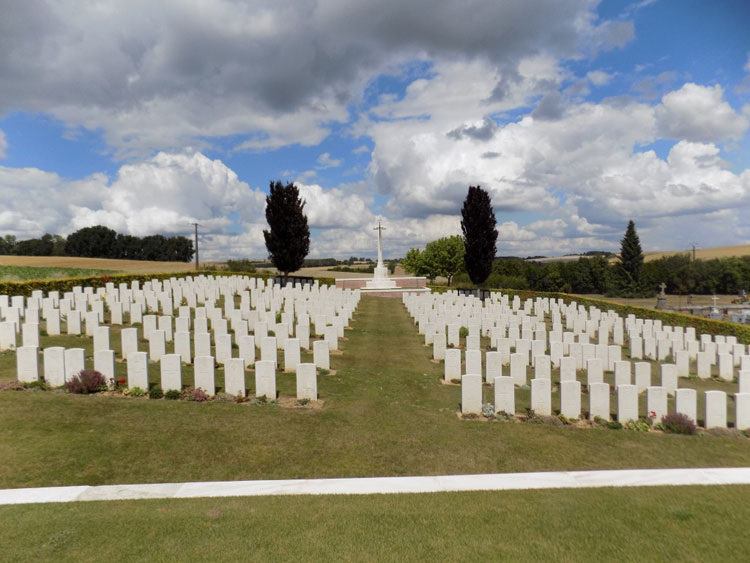
I can find no details of Thomas’s war service, only that when he was killed he was serving with 204th Field ‘Cambridge’ Company which was part of 35th Division and thus the Fifth Army. Field companies provided technical support within a division. They were the engineers of the army. I have no record of how Thomas Pullen was killed but his body was recovered and he is buried in a cemetery on the Somme where he fell.

Back home his wife Florence was left with four children to bring up. Their son Thomas had died in 1915 at the aged of six and his brother Leonard in 1927 at the age of fourteen. Daughter Florence also died young and unmarried in 1930. Her mother married again in 1930 and died in Croydon in 1956. The remaining two children, Albert and Dorothy, married in Croydon and had eight children between them all in Croydon.

The next member of the family to be killed on March 28th 1918 was Albert George Merritt. He was born in April 1894 in Winchester, the eldest son of a serving soldier, George Merritt and Alice Penton who were married in Winchester in the summer of 1893. Five more children followed in Winchester, Alice in 1896, Kate in 1898, Elizabeth in 1900 Alfred in 1901 and Edith in 1904. The family then moved to Alton where Leonard was born in 1908. When George senior left the army the family moved to Peper Harow near Godalming where he became a shepherd and when he left school Albert joined his father on the farm.

When Albert was killed on March 28th 1918, he was a private in the 1st battalion Hampshire Regiment. At the beginning of the war, the 1st battalion was made up of regular soldiers, but by 1918 so many had been lost that it numbered volunteers and conscripts in its ranks too. Albert joined the regiment on Dec 18 1915 and served on the Western Front throughout. By the middle of March the 1st Hampshires were part of the 11th Brigade In advance of the German attack on March 21st, the 1st Battalion were in the second support line and, as with all the other allied troops, were somewhat taken by surprise by the ferocity and tactics of the German attack. Hand to hand fighting took place over the next few days and on the 25th the regiment moved to the front line. In the early hours of the morning on the 28th a huge bombardment took place, followed by wave after wave of attack. The Hampshire’s defended valiantly but were eventually forced to withdraw. At the end of the day, the losses added up to considerable numbers with many men killed wounded or lost. Among those never found was Albert Merritt.

He was awarded the Victory medal and the 1914-15 star and is remembered on the War Memorial at Chiddingfold Church

John Benjamin Lamboll was the youngest of the cousins killed on March 28th 1918. He was born in July 1898 in Haslemere, the only child of Frederick Lamboll and Emma Le Grey who had married the previous summer. John’s childhood was a country one, with his father working as a coachman then later a gardener.

His records are sparse but he was possibly a territorial as he was in the Yeomanry Cycle Regiment and later the 2/7th Battalion Lancashire Fusiliers which was a territorial regiment. The 2/7th were based in Britain on home duties until the end of February 1917 when they went to France. They were on the front line of the morning of the 21st March in a quarry and the German attack took them by surprise and surrounded them. They took up positions in the quarry tunnels but the German guns were too powerful and the battalion was forced to surrender. Many were killed or died in the next few days, so many that the remaining members of the battalion were utilised as instructors for the American troops arriving at the battlefield. Sadly John Lamboll as not among them as his death was recorded on March 28th. He has no grave but is remembered on the Pozieres memorial

In Memory of
Lance Corporal T R PULLEN
87212, 204th Field Coy., Royal Engineers
who died
on 28 March 1918
Remembered with honour
RIBEMONT COMMUNAL CEMETERY EXTENSION, Somme

In Memory of
MERRITT, ALBERT GEORGE
Rank Private
Service No:11270
Date of Death:28/03/1918
Regiment/Service:Hampshire Regiment 1st Bn.
Panel Reference Bay 6.
Memorial ARRAS MEMORIAL


In Memory of
Private JOHN BENJAMIN LAMBOLL
52598, 2nd/7th Bn., Lancashire Fusiliers
who died age 19
on 28 March 1918
Son of Fredrick and Emma Florence Lamboll, of Holly Lodge, Weydown Rd., Haslemere, Surrey.
Remembered with honour
POZIERES MEMORIAL


Sunday, 25 March 2018

Edgar William Guy Luff 1892-1918


Edgar William Guy Luff

5 Sep 1892-25 Mar 1918


Edgar William Guy Luff was born on 5th September 1892 in Croydon, the second of two children born to William Harry Luff and Mary Ann Foster William and Mary had been married on 30th June 1889 in East Dulwich and their first child Winifred was born later that year. Harry was a civil servant who rose to become a chief writer at the war office.

Edgar was educated at St. Dunstan's College, Catford, on whose website there is a detailed biography. His first job after leaving school was a clerk at the Union Assurance Office.

He joined the army on 1st September 1914 and was assigned to the 1/5th Battalion Seaforth Highlanders.  While serving with the Highlanders in France he was awarded the 1914-15 Star. In November 1915, he was given a commission as a second lieutenant and moved to the Hampshire Regiment. In March 1916, Edgar was transferred to the Machine Gun Corps and in the same spring, he married Louisa Channer in South London. In April 1917, their daughter Kathleen Winifred was born and 1st June 1917 he was promoted to lieutenant.

By early 1918, Edgar was serving with the 63rd Machine Gun Brigade, who were deployed to the Western Front as part of the Third Army. What was later to be known as the Spring Offensive was launched by the Germans on March 21st 1918. The allies were taken by surprise and over the next few days German troops infiltrated the allied trenches and despite great bravery by allied soldiers, many were killed or taken prisoner. On the 25th, they reached the area where the 63rd Machine Gunners were operating and attacked. It was at first thought that Edgar Luff had been taken prisoner but an eyewitness account later confirmed that he had died. His body was never found and he is commemorated on the Arras Memorial.

Back home, his wife was expecting their second child and Edna Louisa was born in October 1918. Louisa never remarried. In 1939 she was living with her daughter Edna in Upper Norwood and she died in 1978 in Canterbury. Edna died unmarried in 1982 in Devon while Kathleen married in 1945, had a daughter and moved to Wales.


In Memory of
Lieutenant Edgar William Guy Luff
"A" Coy. 63rd Bn., Machine Gun Corps (Infantry) who died on 25 March 1918 Age 25
Son of M. A. Luff, of 57, Dunvegan Rd., Eltham, London, and the late William H. Luff
Husband of Louisa Mary Luff, of 31, Braeside Rd., Streatham, London.
Remembered with Honour
Arras Memorial

Arthur Owens 1893-1918

Arthur Owens

13 Jul 1893-24 Mar 1918


Arthur Owens was born at Gelli in the Upper Rhondda Valley, Glamorganshire on July 13th 1893. He was the second of ten children born to Edward Owens and Mary Jane Speed who were married in Gelli in the summer of 1889. Their first child Mary Jane was born the following year followed by Arthur in 1893, Ellen in 1894, Wesley in 1897, Sylvester in 1890, Mildred in 1900, Olive in 1905, Mabel in 1907, Ernest in 1908 and Minnie May in 1909. The family attended the local chapel and were thus not baptised as infants but, as often happened in the valleys, the first five children were baptised together on 24 Apr 1901 at the parish church. The family were then living at Lloyd Street and Edward was a coal miner. Gelli and its surrounding villages were mining communities so it is surprising that on the 1911 census, when the family had moved round the corner to Rees Street, Arthur then aged 18 is listed as a boot shop assistant. There must have been a reason why he did not follow his father into the mines, presumably health related.

Three years later, on June 14th 1914 Arthur married Ada Jane Price (my great aunt) at St Sannan’s Church, Bedwellty in Monmouthshire. Their daughter Phyllis Audrey was born in July 1915 in Bedwellty.

Arthur joined the 5th Battalion South Wales Borderers in. The 5th battalion was formed in Brecon in September 1914 and converted to a pioneer battalion in 1915. By July 1915 they were in France. They took part in all of the battles on the Western front over the next three years. As pioneers their work was heavy. They made roads, railways and tramways, dug trenches and tunnels and moved supplies. By March 1918 the battalion was part of the Third Army and were called upon to fight on the front line.

From the beginning of March the pioneer battalions were engaged in digging new trenches in the area around the Somme river. Intelligence had uncovered a plan for a major German attack in order to push the allies back towards the coast. They did not quite know where or when but knew it was coming. The United States would soon be reinforcing the allies and the Germans had to attempt to stop the allies before this happened. The attack was later named The Spring Offensive.

The first attack came on March 21st when at 4.20 in the morning, thousands of guns and mortars suddenly began a massive bombardment. The allies had become used to almost static warfare for many months and this sudden advance took them by surprise.  At the front of the line were elite German soldiers who carried nothing but weapons and so could move quickly into the attack followed by reinforcements. They broke through the lines and attacked from all sides.

Hand to hand fighting ensued as the allied lines were continually broken before troops regrouped and pushed the Germans back. The battle continued over several days and the war diary of the 5th battalion records on the 24th the desperate efforts to defend the allied lines.

 “At 2pm the right flank gave way suddenly and, without warning, two platoons were moved across the Fremicourt-Buapume Road to push back and hold the enemy the reverse side of the ridge. Very severe fighting took place until 4pm when the company had to withdraw owing to right flank being enfiladed.”

With German soldiers inside the allied trenches, the men were withdrawn to the Red line In fact the entire third and fifth armies were ordered to retreat and the Somme area conceded to the Germans.

Inevitably many thousands of men on both sides were killed, wounded or lost. Arthur Owens was listed on March 24th as wounded and missing. It appears that he was never found as he is commemorated on the Arras Memorial

His wife Ada became a nurse and never remarried. By the beginning of World War 2, she was living and working in Brighton but died in Ebbw Vale ten years later at the age of fifty-six. Their daughter Audrey remained in South Wales, marrying in 1940 in Bedwellty and having four children. She died in Cwmbran in 1976.

In Memory of
Private ARTHUR OWENS
39344, 5th Bn., South Wales Borderers
who died age 24
on 24 March 1918
Son of Edward and Mary Jane Owens, of Ystrad, (Rhondda), Glam.; husband of Ada Jane Owens, of 48, Tredegar Rd., Ebbw Vale, Mon.
Remembered with honour
ARRAS MEMORIAL


www.findmypast.co.uk

Monday, 12 February 2018

Edmund Charles Bartlett 1895-1918

Edmund Charles Bartlett 1895-1918

Edmund Charles Bartlett was a distant cousin, my three x great grandfather George Coombes being his great grandfather.

Edmund was the second of eight children born to George Bartlett and Jane Boxall who were married in in the autumn of 1892 in Northchapel, Sussex. Their first child Annie was born the following autumn, followed by Edmund two years later and George in 1896. By the time Frederick was born in 1899, the family had moved to Haslemere where they were to remain and where George found work as a dairyman. The last four children were born after the turn of the century, Letsy in 1901, Leonard in 1903, Norah in 1905 and finally Alfred in 1908. All of the children survived infancy apart from Alfred who died at birth.

Edmund Charles grew up in Haslemere and after finishing school, worked as a gardener before he enlisted on 4 Nov 1915 at Guildford.

He re-attested in November 1915 and was assigned to the Royal Engineers as a driver on 20th April 1916. Three weeks later he went to France and on 29th June 1916 was charged with being absent from 3 o’clock fatigues. He was fined two day’s pay.

On 23rd January 1918, a tragic turn of events was to befall Edmund, who was safely behind the lines in the kitchen of a billet near Boulogne with several other batmen and drivers. These men were acting as servants to officers looking after them and their equipment, cooking for them and driving them around. They were all cleaning revolvers belonging to themselves and to their officers, when one of the men asked for some live ammunition, presumably to check the gun was working. He climbed up to the balcony of the house, fired the revolver, then came back into the kitchen and put the gun on the table. As he put it down, it fired, hitting Edmund Bartlett in the chest and spine.

There are witness statements from all of the men in the kitchen that morning including this one from Edmund, written on February 2nd.
“On the morning of the 23rd January 1918 I had just finished my morning fatigue after which I went to my billet to talk in the usual way. Not noticing what the other batmen were doing I sat down at the table when a report of firearm rang out and I felt a pain in my right breast. This is a true and correct statement of the event.”

Initially he was reported as wounded but he died on 12th February in the 25th General Hospital France. One of the statements reads “Negligently shot by a comrade” Edmund was recorded as not to blame and a note added that the person responsible was tried and convicted by Field General Court Martial on 27 Jan 1918.

He is buried in the churchyard at Neufchatel-Hardelot

Back home the family suffered more tragedy with the death of Edmund’s sister Norah at the end of 1918, sister Annie in 1921 and mother Jane in 1924. His father George married again in 1931 and stayed in Haslemere until he died in 1943.


In Memory of
Driver EDMUND CHARLES BARTLETT
136819, 67th Field Coy., Royal Engineers
who died age 23
on 12 February 1918

Thursday, 26 October 2017

Albert Choney and Frederick Risbridger


October 26th 1917 was the first day of the second battle of Passchendaele. Thousands of allied troops took part in this attack including two of my distant cousins. Here are their stories.

Albert Walter Choney 11 August 1889-26 October 1917

Albert Walter Choney was born on 11th August 1889 at Bramley in Surrey. His parents, William Choney and Alice Carpenter, were married on 14th May 1887 at Holy Trinity Church in Bramley. Their first child William was born in 1888 and the following year the family welcomed Albert Walter. He was baptised at Holy Trinity Church in Bramley a week later.
When the census was taken in April 1891, the family were living at Birtley Road in Bramley, now the A281 between Guildford and Horsham but then, of course, much quieter. William senior was an agricultural labourer and William junior was three years old. Albert was eighteen months while Alice was just a few weeks away from giving birth to Herbert. Two years later, the boys acquired a little sister, Alice and in 1895 another brother Ernest.
In 1901, the family; William, still an agricultural labourer, Alice and the children, William aged 13, Albert aged 11, Herbert aged 9, Alice aged 7 and 5 year old Ernest were still in Bramley. In June of 1902 the family welcomed their last child Annie.
After this the family moved frequently and from information in brother William’s military records, the family were living at Log Carter's Cottage at Epsom Down in 1906 then they moved to Longdown Cottages Ewell, then 40 Walnut Tree Close Guildford. By 1911 they had moved to Batt’s Farm Cottages in Warlingham where William senior was employed as a carter for a market gardener. Only three of the six children were left at home although all were still alive. Albert was aged 22 and a carter as was sixteen year old Ernest while Annie, aged eight was at school.

On Christmas Day 1912 Albert married Annie Mansfield at St Mary’s Church in Ewell. Both were living at Longdown Cottages in Ewell. They are recorded on the electoral registers in 1915 at 37 Providence Place in Epsom. Later that year Albert joined the 2nd Battalion the Queens Royal West Surrey Regiment.

The 1st and 2nd battalions of the ‘Surreys’ were initially made up of regular soldiers who came back from postings overseas in 1914. They joined the British Expeditionary Force in September 1914 as part of the 22nd Brigade of the 7th Division. The scale of casualties in both the 1st and 2nd battalions was horrific; by the end of the first week of November 1914 there were only thirty-two survivors out of a total of 998 men from the 1st Battalion. The 2nd Battalion had suffered 676 casualties. Their ranks were to be filled by Territorials, men from Kitchener’s “New Army” and then Conscripts. One of these was Albert Choney who went to France on 27 Jul 1915. Later that year they were transferred form the 7th to the 91st division.

The battalion fought in all the battles on the Western Front throughout 1915, 1916 and into 1917. At some point Albert was injured because he is found recuperating at Bury St Edmunds in November 1916, the same month as the announcement in the London Gazette of his having been awarded the military medal. By the autumn of 1917 he was back in Belgium and fighting again with the Royal Surrey Regiment.

October 26th 1917 saw the first day of the Second Battle of Passchendaele.  The intention of this battle was to reach and take the occupied high ground around Passchendaele in order to cut off the supply lines for the German forces from Ostend and Zeebrugge. Many hundreds of troops from battalions all over the commonwealth were involved. The plan for the battle was given to officers in a secret order on the 23rd of the month and recorded in the war diary.

“The battalion will march to camp at Fernoy Far today.” “Strict attention will be paid to march discipline and to dress. No unauthorised articles may be worn outside equipment. Dress – F.S. (Field Service) Marching order. Steel helmets will be worn.”

The attack was planned meticulously and involved troops attacking en masse under the protection of gunfire. “The attack will be carried out under an artillery barrage which will be put down in depth by guns of all calibres.” The troops were to form two long lines and, “the strictest precautions will be taken to prevent betrayal of assembly by noise or movement. Bayonets will not be fixed until zero hour.”

Air attacks were also planned for “The rear platoons of each company will keep one Lewis gun section to deal with low flying aeroplanes.”

The story of the 26th October is told. The men formed up in a long line and started the attack at six in the morning and all was going well until the main operations post was struck by a shell. The ground was sloping which meant that some sections of the brigade were able to advance more quickly than others. It also meant that German gunners were able to attack them while they were struggling through the mud uphill. Many officers were killed or wounded and the men lost their line of command. There was general confusion and the soldiers converged on the command post thus breaking the line. It was filled in again as quickly as possible with men who had become separated from their units. However, enemy shelling was intense and there were many casualties both among officers and men. Many more soldiers were recorded as missing than killed in this battle, one of those being Albert Choney.

He is commemorated on the Tyne Cot Memorial.

Albert’s wife Annie did not marry again Her parents were dead and she appears to have become very much part of the Choney family. She lived near them in Epsom for the rest of her life and when she died in 1939 was buried at Epsom Cemetery. The inscription on her grave reads “Wife of Albert Walter Choney, Daughter in law of William and Alice Choney.”

William and Alice’s four sons all went to war and only Herbert and Ernest returned. Their older son William died in November 1914.  The remaining children, part from Annie, all married and had children and the family still live in the Epsom area.

CHONEY, ALBERT WALTER
Service Number S/505
Died 26/10/1917
Aged 28
2nd Bn.
The Queen's (Royal West Surrey Regiment)
M M
Son of William George and Alice Mary Choney, of 15, Beaconsfield Cottages, East St., Epsom; husband of Annie Elizabeth Choney, of 10, Beaconsfield Cottages, East St., Epsom, Surrey.


Frederick Victor Innes Risbridger 1887-1917

Frederick Risbridger was born in the autumn of 1887 in Wonersh in Surrey, the second of seven children of Henry Risbridger and Catherine Hankins. Henry and Catherine were married on 24 Oct 1884 at Shamley Green in Surrey. Their first child Henry William was born the following spring, followed by Frederick two years later and Ernest George two years after that. The first girl, Hilda Sarah joined the family in 1893, then another boy, Alfred John in 1895. The family was rounded off by Margaret Frances in 1901 and Robert James in 1903. All the children were born in Wonersh but baptised either at Shamley Green or Graffham. In 1901 the family were living at Rooks Hill in Bramley, moving over to Shamley Green by 1911. Henry, the father of this large family, worked as a shepherd.

Frederick joined the army on 22nd November 1915 at which time he was living at Goose Green near Bramley. He joined the 2/5th battalion of the Royal Lancaster Regiment which trained in the UK until February 1917. The battalion was part of the Territorial Army and formed in Lancashire, although by the time Frederick joined in Guildford they were based in Sevenoaks in Kent. Later they moved to Aldershot and in February 1917 were mobilised for war arriving in France in late February. The first battle in which they took part was the Second Battle of Passchendaele which began on 26th October 1917.

The intention of this battle was to reach and take the occupied high ground around Passchendaele in order to cut off the supply lines for the German forces from Ostend and Zeebrugge. The role of the 57th division, of which the Lancasters were part, was to provide diversionary assaults to enable Canadian troops to mount the main offensive at the northern end of the line. The weather in the run up to October 26th was severe with heavy rain making the ground treacherous with deep mud. The Canadian war diary for the week before the battle records that working parties laid wooden boards on which to march but they became so slippery that men were in danger of falling off and being lost in the boggy ground.

Many thousands of troops from divisions all over the commonwealth were involved in the battle of October 26th. The attack began at 6 in the morning and initially some progress was made but the mud and opposition firing forced a retreat so that at the end of the day they were back where they had started.

Among the many soldiers who did not make it back that day was Frederick Risbridger. When the roll call was taken at 6pm, he was one of many men who were missing presumed dead.

After the war, Frederick’s parents and almost all of their children continued to live in the villages south of Guildford. Their youngest son, Robert, emigrated to New Zealand in 1947 with his young family. Only three of the children married and from seven children, Henry and Catherine only had four grandchildren.

Remembered with Honour
Tyne Cot Memorial
In Memory of
Private Frederick Risbridger
28581, 2nd/5th Bn., King's Own (Royal Lancaster Regiment) who died on 26 October 1917 Age 29
Son of Henry and Caroline Risbridger, of Selhurst Common, Bramley, Guildford, Surrey.

Rickard, J (17 August 2007), Second Battle of Passchendaele, 26 October-10 November 1917 , www.historyofwar.org/articles/battles_passchendaeleII.html